The alarm went off at 4:30am sharp and I was up drinking hot instant coffee for a change because the stove was already set up from dinner. We were out the door with cameras, water, Oreo s, and headlamps to the trail head in Tingo. We followed the river for 2km then started climbing for the next 8km until we were 1000+ meters higher. The sun started coming up by 6am so we could turn off the headlamps and enjoy the sun rising on all the mountains we had yet to climb. The terrain changed from desert scrub to high sierra pastures as we passed through a stock gate. Small farms started to appear then passing through a small village the walls appeared.We made the hike in good time taking 2.5 hours, of course, everyone asked, it was a nice change up from the bike. The walls appeared as a cliff encircling the escarpment with a narrow gap entering the fortified city that would force enemy armies to single file into the city. . . and die.
The only other people present were excavating/restoring the site, though later we sighted “pockets,” a mumbling German I nicknamed for his pants. Otherwise we had the site to ourselves to crawl over for 2 hours until other people showed up.
Kuelap is only partially excavated and still over grown with bromiliads. Grazing alpacas help keep the grass down. My favorite archeology sites are generally lightly excavated. The complete restoration of a site strikes me less as reconstruction and more as erasure – a negation of time - a reflection of our own desire. The power of these sites is to see once dominant civilizations, no doubt assured of their own perpetuity just as we are, over grown and munched on by alpacas. This too shall pass. The site did not give much information about the Chachapoyan culture because not much is known and the information provided was fairly obvious, like this was where people lived or this is a big wall. Kuelap is noted for certain architecture and design features like the high walls, relief carvings, round structures, and commanding views of the surrounding countryside.
The ongoing restoration project was well funded with a joint grant from the Peruvian and Italian governments. People were bustling about digging, studying, hauling, and rebuilding.
After three hours or so, we headed down to the official entrance with the intent to catch a ride back down the road to Tingo – walking down is more painful than up and we had some hard days ahead. But our early start meant we were finishing up as everyone else was arriving which forced us to hang and wait for a few hours while people went up and came back down. We found a little shade, watched people arrive naming nationalities, talked with cab drivers, and watched the locals work. The real impact of Kuelap was on the local economy. The archeologists and workers at Kuelap all needed to be housed, fed, and supplied beer. Additionally, you cannot drive to the sight which meant everything had to hauled up. Horse load after horse load of sand for mixing mortar went up the mountain. 20 soles per horse per trip each horse
carrying roughly 200+lbs of sand. Locals were also selling snacks and water to hungry people like me. A large truck full of eucalyptus logs pulled up for the scaffolding. I am pretty sure they
would have to be carried up individually by people because horses could not haul them around the switch backs. Just watching the logs unloaded was entertainment enough for 45 minutes.
Eventually, we got a ride from the taxi driver we were chatting with and two other folks. The road down was a tortuous single lane dirt road for 35km that takes over 1.5 hours to drive because it is in rough shape and would have been far faster on a bike. We passed through a series of small farming villages (growing potatoes, coca, and corn) that are trying to capitalize on the tourism to Kuelap . . . but that seemed about as slow as the road. Reminded me of a Darwin quote, “we will now discuss in a little more detail the struggle for existence.”
After meeting up with Dylan in Chachapoyas I took two rest days there to do the usual rest day activities – laundry, write, bike repair, and eat. First thing, I reboot my front tire with some thick inner tube rubber I found on the road and now feel confident that it is good for the life of the tire . . . however long that may be. Chachapoyas was the first decent size city I had been in since Loja,Ecuador – though smaller, probably under 20,000 people, certainly no universities, coffee shops, or bookstores. But a nice plaza, decent market, and churros - nice to be back in churro country (fried dough sticks with sugar). Also, Chachapoyas has tourists, mostly German and French, there as a jumping off point to the site of Kuelap. I hadn't seen any tourists in awhile. Food in Peru is cheap and good with the menu, a set meal of soup & main course, costing 3-5 soles. So Dylan and I set out a few times a day to see what the locals were eating, then snack in between. Ceviche is once again common and I introduced Dyaln to the wonders of papas a la huancaina – potatoes in cheese sauce with an egg. The market was filled with colorful variety of fruits, vegetables, grains, and meat that makes shopping fun – which of those four types of avocado? Or which of the dozen varieties of potato? Every type of fruit fresh. I guess we were like most tourists because we were in Chachapoyas as a jumping off point for Kuelap. Kuelap is a large Chachapoyan (pre- Inca) fortified city on a mountain top often compared to Manchu Pichu, though harder to get too. Consequently, Kuelap receives as many visitors a year as Manchu Pichu does in a day – and that is being generous. Also, Kuelap has been on my tick list for decades. We left Chachapoyas late morning for a short 50km ride down to the river valley then along the Utucamba River to Tingo where we planned to spend the night then hike up to the site early the next morning. The riding was pleasant and quiet along the river with small farms scattered along the riparian bottom land. Approaching Tingo we spotted our first Chachapoyan ruins blending into the canyon walls.Tingo Viejo was a small bus stop town along a dusty dirt road with a few small stores, two hospedejas with restaurants catering to people headed to Kuelap. The town, once bigger, had been buried in a huge mud slide several decades earlier, consequently Tingo Nuevo was rebuilt on higher ground. After checking into Hostal Leon (15 soles), we walked around the corner, bought a beer, and sat on the curb to watch the local action. Three archaeologists (one US, two Peruvian) were sitting on the bench waiting to hitch a ride up valley so we chatted and turned out to know some people/places in common, then they hopped in a police truck and were off. We bought a beer. The occasional bus pulled up to discharge a couple backpackers – conspicuously viewing their Lonely Planet. The woman vendors would grab handfuls of fruit run up to the bus to sell to passengers. We bought a beer. A chicken delivery truck pulled up to sell a dozen or sochickens – our next meal. Meanwhile, a combi was loading up people and stuff. We bought a beer. Dogs and donkeys move through town on autopilot to their next destination . . . we bought a beer and decided to go fishing. Fishing, not catching, but fun none the less. We returned to our room, cook dinner on our stoves, and turn in early after chatting with a German climber over some Pisco. Tomorrow is going to be early, a 4:30 am alarm, to hike the 1000+meters up to Kuelap for morning light.
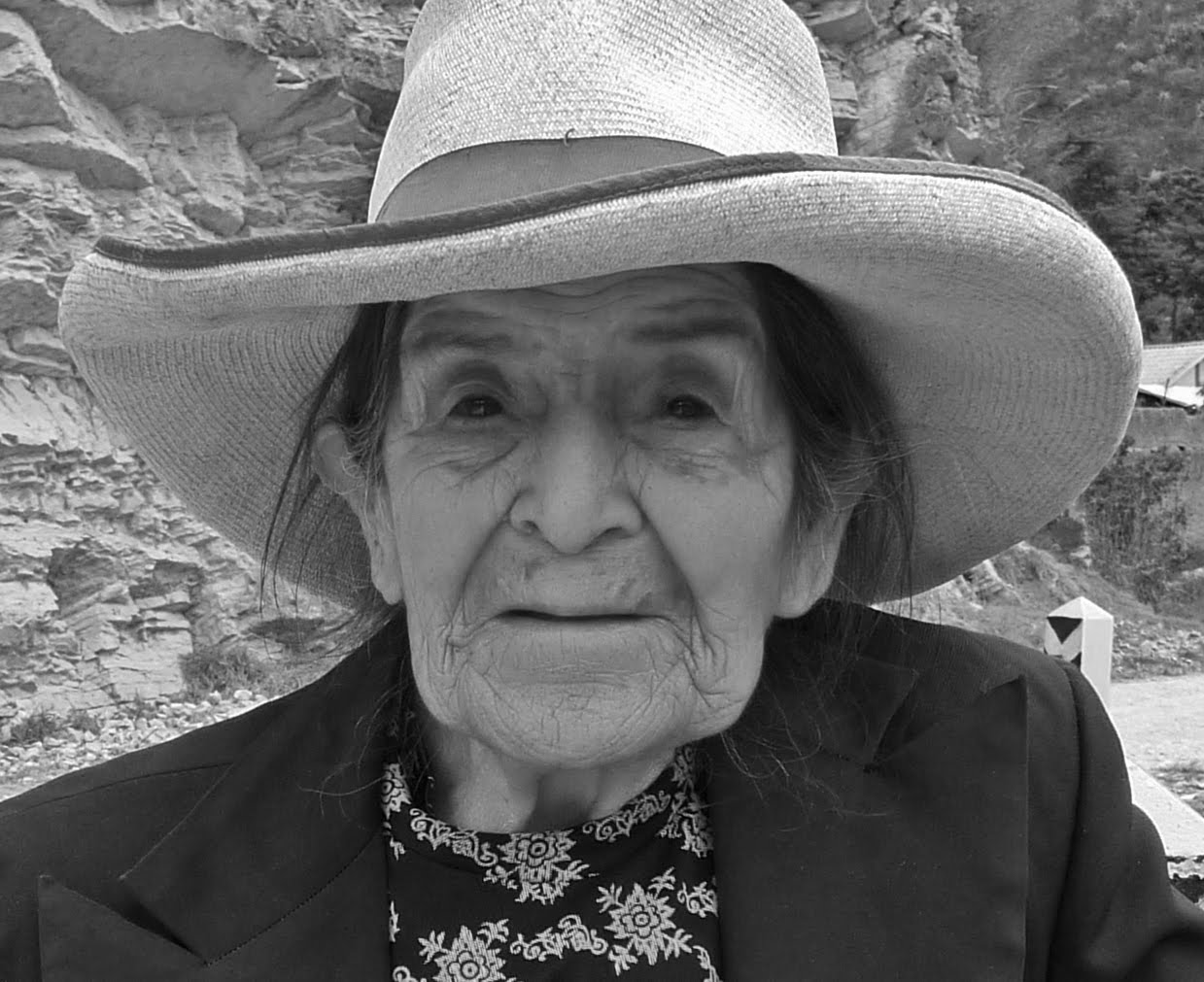
We were sitting on the Santo Tomas bridge eating lunch when she approached smiling and telling us not to fall into the river. ¨Gringitos,¨ she said, ¨una propina, por favor.¨ I gave her two soles for a photo in exchange. She was more than happy to have her photo taken then walked off.
Peru has no social security, her husband was probably long gone and children moved away to a place with more opportunity, if they were living. Hard to say no.
I left the swarming mototaxis of San Ignacio after a two day rest not sure what to expect but knew I was headed downhill and the road was going improve eventually to pavement. There are few private vehicles in Peru, maybe one in 15 vehicles that I see are private transportation. Mototaxis (3 wheeled motorcycle) are the most common, then corolla station wagons, then vans (combis). So once I get out of San Ignacio the roads are quiet and good thing because I need the entire breadth of the road to maneuver around pot holes and move to the outside of turns. Once again glad for my full size mountain bike tires while dropping 1000 meters to the Rio Chinchipe. Along the river valley I figure out it is going to be a hot and dusty day dodging pot holes. But gradually bits of tattered pavement appear as I head downriver toward Bellavista where I plan to catch a boat across the Rio Maranon. The landscape reminds me of the Western Slope of Colorado with its big river and high dry mountains - except for the banana trees, of course.
The few towns along the road are on the opposite river bank requiring a cable guided ferry to access or just a cable. People are friendly and curious - a family of three plus a chicken stop on their motorcycle to chat and gave me their cell phone numbers if I needed anything. Though, I do get tired of being called gringo all day by endless children and adults by the road. Gringo! Gringo! I feel like a rare animal sighting, which I suppose I am.As the river valley broadens I begin to pass rice paddy after rice paddy, endless rice. I love rice, rice feeds the world, I eat rice 3 times a day, and the rice here is sweet with a little bite at the center. I watch people prepare rice paddies, plant rice plants, paddies with bending stalks heavy with grains, paddies already harvested – all stages of rice production happening at one time. The growing season here does not change - 12 hours of light and 12 hours dark, always warm, always sunny, all the water you need coming down from the mountains. A quintessential pastoral landscape appearing timeless, simple, and honest. Oxen harnessed in the field. The bottom lands an endless even green that I pass accompanied by the constant babble of water flowing over the paddies, hunting cranes perched over the beds, bordered by papayas, bananas, and corn. The landscape is pregnant with life and all things good to eat. But I stop at a small tienda to buy a coke and to sit on the stoop as men pass on motorcycles with chemical sprayers strapped to their backs, I see figures prostrate in water to their shins plugging rice plants into paddies under the same hot sun I ride under . . . How much does rice cost? How much do you have to grow to make a living? The homes I pass are wattle and daub (woven sticks plastered with mud). Who owns a truck to bring their rice to market? Do all these children have schools or teachers? An easy landscape to romanticize but you can only do that for so many hours sweating on a bike. Towards dark I turn off the paved road onto dirt to Bellavista and more rice. The town is small and sees few foreign tourists . . . but it is on a road that dead ends at the Rio Maranon. I roll into the plaza and begin conversation with several men leaning on their mototaxis, as more gather I am directed to a hospedeja (small hotel) on the plaza and check in for the night (10 soles).Come morning I drink my cold instant coffee and work on my bike for a couple hours - changing back to road tires and tightening loose bolts. After a breakfast of soup, rice, yucca, and beef I head down to the river bank along a rough dirt track through rice paddies to catch a small motor boat to the other side. The crossing is not heavily used but saved me over 50km of riding through the city of Jaen. I head away from the landing on a sandy track passing a PetroPeru facility and helicopter pad to the main highway. The road is in decent shape paralleling the Rio Utcubamba heading upstream. Over the course of 80km the valley begins to narrow heading higher upstream steadily climbing but rarely steep (with a few notable exceptions). Road construction is interspersed throughout whether it is crews hand scraping guardrails to be repainted, paint crews hand painting center lines, or heavy machinery routing the road through landslides. They are friendly and encouraging - I sometimes think I must be winning the race . . . I think they welcomed the distraction. Also, dump trucks in Peru are the friendliest yet. Approaching Pedro Ruiz the canyon is filled with the sound of rushing water and parrots nesting in the cliffs. Once again, I pull into Pedro Ruiz at nightfall to check into a nice hospedeja in the town center (10 soles), take a cold shower (only option) and eat. I realized I have covered as much distance in the past two days as the last week (over 200km).
The next morning I resume my climb up the Rio Utcubamba anticipating a short 43km day, according to the map. I pass coffee laying out to dry beside the road which means I climbed over 1000 meters yesterday upstream to get over 2000 meters where coffee is grown. The road is quiet and beautiful as the canyon narrows - I was going to try out my new fishing pole but the no fishing signs were a little too obvious for me to plead ignorance. The canyon narrows down enough that the road is cut into the side of the wall. Eventually, the road turned off for Chachapoyas at 40km meaning I had 10km to go . . .
Well, I can't say I was not warned . . . but then at 50km the city was not in sight! Just plain rude, I thought. However, I did get some good views of the valley I climbed out of . . . and will descend to leave. Chachapoyas is pretty small so I quickly find the central plaza and walk into the first hotel to start shopping but am really thinking about eating a chicken. . . and who is there but Dylan with an extra bed is his room. Small world, indeed.
8.05.2010
Not sure what is going on here . . . humor? Initially, I did not notice it was written in English and could not figure out what was being said. I thought, "uh, that's strange the guy must be Arabic." But I noticed another roadside cross with English words a couple days later. . . Nobody actually speaks English around here other than "hello" and "mister," of course. Anyhow, you certainly did not want to go off the road.