USHUAIA OR BUST ROUTE MAP

8.19.2010

Up Up and Away

Tingo – Leimebamba – Abra Barros Negros – Balsas –We rode from Tingo up the river valley to Leimebamba where we finally leave the Utucamba River valley after 200+km. Road is still quiet and the towns are quieter - with not much bar action but the pigs are friendly. Leimebamba is small and we see the same folks from Tingo and Chachapoyas. But it was a charming place to eat, get a hot shower, and spend the night. I pick up a bag of coca leaves to chew and a gourd for "cal," or quicklime, in anticipation of the big climbs ahead. Coca is traditional to chew in the highlands, helps with altitude, nice energy, and good to share. Coca leaves are legal in Peru and readily available but people never sell the cal with the leaves . . . why, I do not know? But you always have to go to a hardware store to get the cal (used for masonry). The cal, or quicklime, is mixed in small amounts with the coca leaves in your mouth to release the alkaloids from the coca leaves. I went to a corner hardware store to buy some cal and the owner then led me back to the hostal I was staying at, then into a back storage/living area where we sampled some cal out of 50kilo bags to get some that was "hot." The hard part was getting the powder into a hole the size of a pen top at the top of the gourd, but it was free, and we chatted after wards. Peruvians are always a little surprised when a gringo chews coca leaves . . . I just like the gourds.
We start out a little late in the morning because we want to see if the day will clear or if it will rain and neither of us want to climb a big pass on a dirt road in a cold rain. Also, I wanted to see the museum on the outskirts of town that did not open until 10am where Dylan continued on. The museum is small but obviously well funded, probably due to a unique collection of over 200 mummies all from Laguna de los Condores. A large collection of well preserved dead bodies from the same place over a given time available to study is an evolutionary biologists wet dream. Overall, the museum, while nice, is sparse on information about the actual Chachapoyan culture because not much is known. They called “warriors of the clouds,” but eventually subjugated by the Inka Empire, then allied themselves to the Spaniards, the enemy of my enemy . . . Take your pick of imperialists. However, I did learn some things about contemporary Andean cultures and architecture.


Curious Head Wear

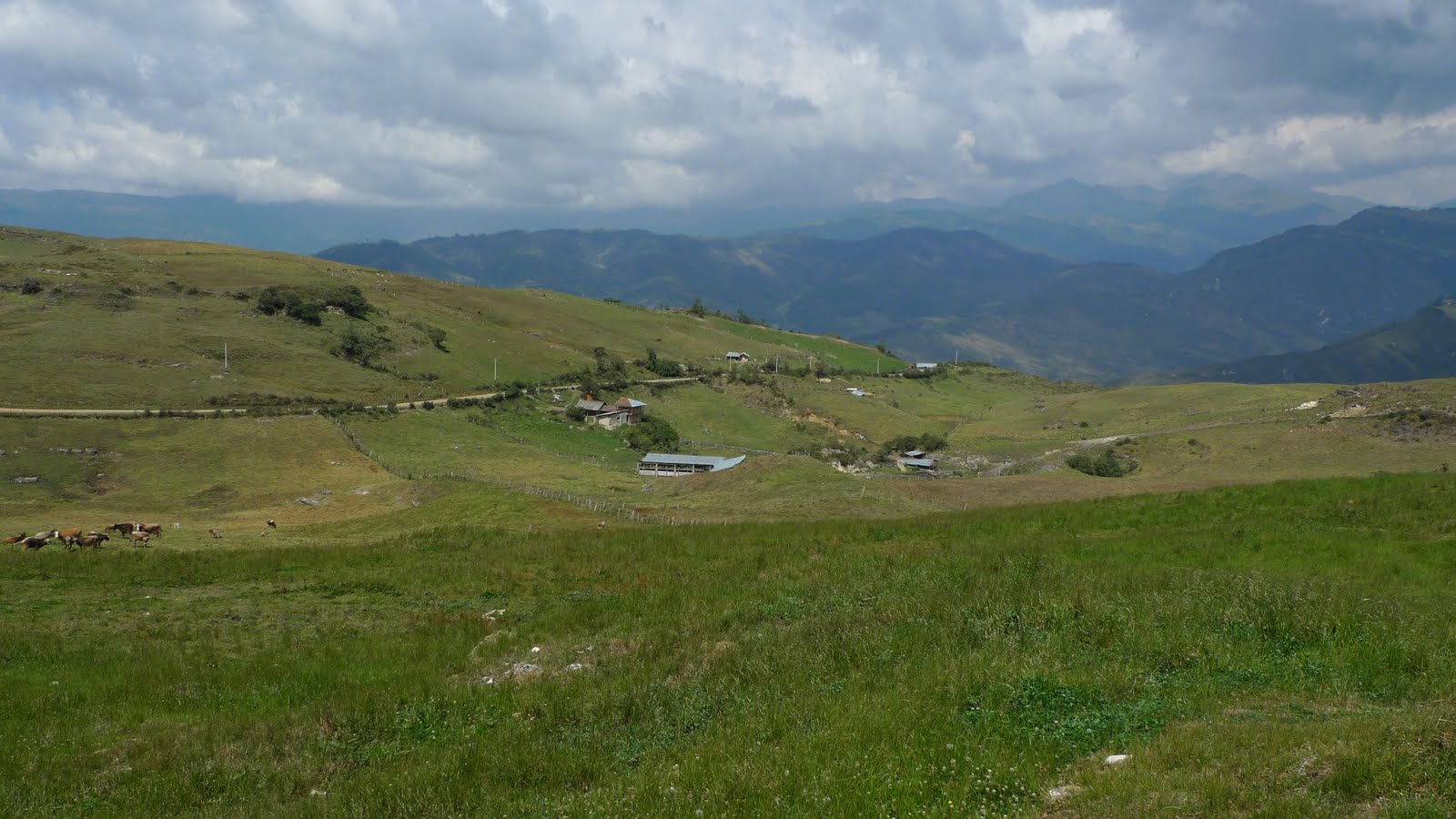
Then the climbing began on a beautiful narrow dirt road with little traffic. Passing through small farming communities for the 30 kilometer climb up to 3620 meters over the Barros Negros (black mud) pass – thankfully, it was dry. I stopped for lunch after climbing for a couple hours while finishing up lunch a young man stepped off a bus and walked over to talk - curious about a gringo in full bike regalia with a touring bike. I was just opening my bag of coca leaves for the climb and offered. He gratefully accepted and we chatted while sharing coca leaves. He was going to hike up to a small farm (potatoes and corn) about two hours into the mountains. The sharing of coca is a traditional social practice in the high Andes, that I have used often in the past, and was glad to have some to share because it is a real ice breaker. The views were expansive as the landscape of the high sierra opened . I topped out at 3pm and prepared for a long descent of over 2800mts to Chacanto. I would need maybe 10 pedal strokes for the rest of the afternoon. I had to tell myself to get riding and stop taking photos if I wanted to complete the 60km descent before dark. Even if I was standing on the local dump it was still breathtaking. I had clear views of long stretches of the descent, which was important because the road was narrow, single lane, bailing to the left was impossible because it was usually a wall and to the right was the drop for life. I figure the best you could hope for was to die quick otherwise you were going to land in a crumpled broken heap a thousand feet down to die slowly with no one knowing you were even there. Reminded me of the Buddhist phrase “abandon hope” - best to leave nothing to hope and pay attention to your task at hand. Sections of the road were literally carved into cliff face with room for only one vehicle. Signs warned about excessively narrow sections and told drivers to honk their horns before rounding single lane hairpin turns. Eventually I arrived in the Maranon river valley towards dusk and met Dylan sitting on a bench in the plaza where we had a well earned ice cold beer. The town turned out to be very small with half the residents playing volleyball by the plaza in front of the police station and a single house renting rooms, well a room, with the bathroom “down by the river.” We ate, had a couple beers then passed a hot stuffy night with the black flies before rising for the next big climb.
8.17.2010

Kuelap

The alarm went off at 4:30am sharp and I was up drinking hot instant coffee for a change because the stove was already set up from dinner. We were out the door with cameras, water, Oreo s, and headlamps to the trail head in Tingo. We followed the river for 2km then started climbing for the next 8km until we were 1000+ meters higher. The sun started coming up by 6am so we could turn off the headlamps and enjoy the sun rising on all the mountains we had yet to climb. The terrain changed from desert scrub to high sierra pastures as we passed through a stock gate. Small farms started to appear then passing through a small village the walls appeared. We made the hike in good time taking 2.5 hours, of course, everyone asked, it was a nice change up from the bike. The walls appeared as a cliff encircling the escarpment with a narrow gap entering the fortified city that would force enemy armies to single file into the city. . . and die.


The only other people present were excavating/restoring the site, though later we sighted “pockets,” a mumbling German I nicknamed for his pants. Otherwise we had the site to ourselves to crawl over for 2 hours until other people showed up.


Kuelap is only partially excavated and still over grown with bromiliads. Grazing alpacas help keep the grass down. My favorite archeology sites are generally lightly excavated. The complete restoration of a site strikes me less as reconstruction and more as erasure – a negation of time - a reflection of our own desire. The power of these sites is to see once dominant civilizations, no doubt assured of their own perpetuity just as we are, over grown and munched on by alpacas. This too shall pass. The site did not give much information about the Chachapoyan culture because not much is known and the information provided was fairly obvious, like this was where people lived or this is a big wall. Kuelap is noted for certain architecture and design features like the high walls, relief carvings, round structures, and commanding views of the surrounding countryside.

The ongoing restoration project was well funded with a joint grant from the Peruvian and Italian governments. People were bustling about digging, studying, hauling, and rebuilding.

After three hours or so, we headed down to the official entrance with the intent to catch a ride back down the road to Tingo – walking down is more painful than up and we had some hard days ahead. But our early start meant we were finishing up as everyone else was arriving which forced us to hang and wait for a few hours while people went up and came back down. We found a little shade, watched people arrive naming nationalities, talked with cab drivers, and watched the locals work. The real impact of Kuelap was on the local economy. The archeologists and workers at Kuelap all needed to be housed, fed, and supplied beer. Additionally, you cannot drive to the sight which meant everything had to hauled up. Horse load after horse load of sand for mixing mortar went up the mountain. 20 soles per horse per trip each horse

carrying roughly 200+lbs of sand. Locals were also selling snacks and water to hungry people like me. A large truck full of eucalyptus logs pulled up for the scaffolding. I am pretty sure they

would have to be carried up individually by people because horses could not haul them around the switch backs. Just watching the logs unloaded was entertainment enough for 45 minutes.

Eventually, we got a ride from the taxi driver we were chatting with and two other folks. The road down was a tortuous single lane dirt road for 35km that takes over 1.5 hours to drive because it is in rough shape and would have been far faster on a bike. We passed through a series of small farming villages (growing potatoes, coca, and corn) that are trying to capitalize on the tourism to Kuelap . . . but that seemed about as slow as the road. Reminded me of a Darwin quote, “we will now discuss in a little more detail the struggle for existence.”

Chachapoyas to Tingo

After meeting up with Dylan in Chachapoyas I took two rest days there to do the usual rest day activities – laundry, write, bike repair, and eat. First thing, I reboot my front tire with some thick inner tube rubber I found on the road and now feel confident that it is good for the life of the tire . . . however long that may be. Chachapoyas was the first decent size city I had been in since Loja, Ecuador – though smaller, probably under 20,000 people, certainly no universities, coffee shops, or bookstores. But a nice plaza, decent market, and churros - nice to be back in churro country (fried dough sticks with sugar). Also, Chachapoyas has tourists, mostly German and French, there as a jumping off point to the site of Kuelap. I hadn't seen any tourists in awhile. Food in Peru is cheap and good with the menu, a set meal of soup & main course, costing 3-5 soles. So Dylan and I set out a few times a day to see what the locals were eating, then snack in between. Ceviche is once again common and I introduced Dyaln to the wonders of papas a la huancaina – potatoes in cheese sauce with an egg. The market was filled with colorful variety of fruits, vegetables, grains, and meat that makes shopping fun – which of those four types of avocado? Or which of the dozen varieties of potato? Every type of fruit fresh.
I guess we were like most tourists because we were in Chachapoyas as a jumping off point for Kuelap. Kuelap is a large Chachapoyan (pre- Inca) fortified city on a mountain top often compared to Manchu Pichu, though harder to get too. Consequently, Kuelap receives as many visitors a year as Manchu Pichu does in a day – and that is being generous. Also, Kuelap has been on my tick list for decades. We left Chachapoyas late morning for a short 50km ride down to the river valley then along the Utucamba River to Tingo where we planned to spend the night then hike up to the site early the next morning. The riding was pleasant and quiet along the river with small farms scattered along the riparian bottom land. Approaching Tingo we spotted our first Chachapoyan ruins blending into the canyon walls.Tingo Viejo was a small bus stop town along a dusty dirt road with a few small stores, two hospedejas with restaurants catering to people headed to Kuelap. The town, once bigger, had been buried in a huge mud slide several decades earlier, consequently Tingo Nuevo was rebuilt on higher ground. After checking into Hostal Leon (15 soles), we walked around the corner, bought a beer, and sat on the curb to watch the local action. Three archaeologists (one US, two Peruvian) were sitting on the bench waiting to hitch a ride up valley so we chatted and turned out to know some people/places in common, then they hopped in a police truck and were off. We bought a beer. The occasional bus pulled up to discharge a couple backpackers – conspicuously viewing their Lonely Planet. The woman vendors would grab handfuls of fruit run up to the bus to sell to passengers. We bought a beer. A chicken delivery truck pulled up to sell a dozen or so chickens – our next meal. Meanwhile, a combi was loading up people and stuff. We bought a beer. Dogs and donkeys move through town on autopilot to their next destination . . . we bought a beer and decided to go fishing. Fishing, not catching, but fun none the less. We returned to our room, cook dinner on our stoves, and turn in early after chatting with a German climber over some Pisco. Tomorrow is going to be early, a 4:30 am alarm, to hike the 1000+meters up to Kuelap for morning light.