
The week spent in Panama City was largely concerned with running a few errands, like new bike shorts, and finding a way around the Darien Gap. The Darien Gap is the stretch of land connecting the North and South American continents. The Darien has no road traversing the two continents. The Panama side of the Darien is mere 99 miles long and 31 miles wide, while the Colombian side is shorter but 80 miles wide. The distances hardly sound like an obstacle, yet, the

Darien is known as one of the wildest and least accessible places on the planet. The Panama side is mountainous rain forest ranging in elevation from 200 to 6000 feet while the Colombian side is 50/50 marsh land and swamp. Each side is home to various peoples not interested in being contacted – narco-traffickers, paramilitaries, guerrillas and indigenous. Additionally, there is little international will to bridge this gap because it serves as a barrier to disease, as well as, illicit trade. If I crossed the Darien by bicycle it would be international headlines either because I succeeded or failed ending up dead and/or kidnapped.
I may be a little crazy but . . . ultimately, decided to take a boat. At the hostel I met Adam, the amiable co-owner of a boat, the Darien Gapster, and based largely on his good character, booked passage on the brand new 31 foot motor launch.( http://www.thedariengapster.com/) The design is just like what they use to run drugs, and even built by the same guys who build boats for the guys who run drugs, with two 200hp outboards. Sounds sturdy and fast to me. After a couple inevitable delays we were set to leave from Portabello, Panama on the Caribbean coast on a Tuesday morning. Matt and Paul pedaled the 100km over on Sunday and I left with Dylan, another cyclist we met in Panama City, on Monday.
After spending a week traveling around Panama City I knew I did not want to ride out the length of the city on the highway so we cut across the city towards the canal and rode out past the cranes. I was a little concerned to avoid the “bad” neighborhoods and suicidal traffic scenarios. Our route was perfect! 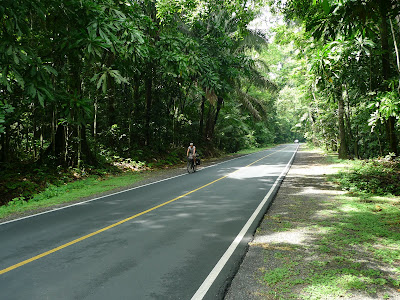


We were out of the city with a minimum of hassle and only had to back track once(in a wealthy neighborhood), then we rode past the locks and were into national park bordering the entire canal. We crossed the Isthmus of Panama on old roads to the Caribbean riding out the undulating coast to Portabello, home to the first counting house in the New World. Decaying fortifications testify to numerous pirate attacks lusting after Spanish gold. The rusted canons oversee a sleepy bay lightly populated with small boats. While, offshore is the purported resting place of the infamous pirate Sir Francis Drake, or at the very least an island named after him.
The night was a hectic combination of reunion with the folks from the hostel in Panama City, shopping for supplies, making dinner, sorting out gear, and packing up our bicycles to be loaded on the boat. After loading our bikes into the back of a mini van around midnight, Matt and Dylan

rode with them down to the dock to help with loading and insure their safe packing. Between the four of us we have over 70,000 kilometers of bike travel, lots of experience with bikes on public transport, and were determined that none of the delicate dangling bits get broken off.
 Morning came early because it was early but I was able to take some nice sunrise photos . . . not that I wanted any. Everyone grabbed their bags, schlepped down the hill to the dock, and we piled in our seats. Because our bikes were at the front we sat at the front, which I normally avoid in motor launches because of the rough ride, but over the course of the trip, protected from the spray, we stayed the driest.
Over the next three days we motored through the San Blas Islands belonging to the Kuna people. In order to visit the islands it is necessary to obtain permission from the Kuna Nation, otherwise the area is closed to outsiders.  The Kuna support themselves through a variety of means: selling handicrafts on the mainland, out migration for seasonal work, fishing, farming in the Darien on shore, and fees charged to visiting boats. The woman are easy to recognize with beaded leggings, colorful print short skirts, a colorful band of print material around their middle, and another around their tops. All of which contrast or at times clash (to conventional thinking). My initial thought was an indigenous Cindy Lauper. They make the parrot fish look dull.
  The Kuna we met were open and hospitable, however, I have few photos because it is rude to take their photo. Fortunately, Marco, the boat captain and ex-pat Quebecois, had personal friends among the Kuna and we spent the first night camping with a family in their compound.
 Before sunset we were led around the village for a brief tour – the tour could not be anything but brief considering the island could not have been more than 3 acres and 450 lived there. I was not really sure who was on display in the end as we paraded through the meticulously clean village of palapa huts
 During the days we broke up the boat ride with stops at various islands to swim, snorkel, and eat lunch. At night we stopped at another island to set up camp, cook dinner together, drink rum, swap stories, and listen to guitar masters Adam and Jihan.
  Invariably, during each stop Kuna from the surrounding villages would stop by to offer seafood for sale and/or insure that we had adequate permission and fees were paid. I was impressed by their hospitality and their seeming independence.
The evening of day three we disembarked at the village of Sapsurro and were officially in Colombia and South America - a new continent.  The dock was busy with locals and military personnel. We all noticed the rocket propelled grenades on their chests and not all safeties were engaged on the automatic rifles. We were still in the Darien and now in Colombia, however people were friendly and curious. After unloading and presenting our passports we walked down the beach to a hostel owned by a Chilean named Lucho, another friend of Marco's, and a great place. The table always had mangoes and avocados for the taking from the surrounding trees. As I rocked to sleep in my hammock I heard fruits thunk to the ground.
Upon waking in the morning the first order of business was to hike over a ridge to the next town of Capurgana to go through Colombian immigration. Both towns lacked access by road and required hiking through the jungle, not recommended (or possible) for long distances, or taking a boat along the coast. The hour and half hike was steep and slippery with lots of spiders that gathered in large groups in a tangle of webs, and offered a nice view of the village of Sapsurro
 Immigration was painless but after questioning we were granted only 30 day visa stamps without proof of adequate funds, not a big deal considering you can get your visa renewed at any regional capital.
 Then it was onwards to booking our next two hour boat ride out of Capurgana to Turbo, where we could finally access roads on the mainland of Colombia. There is only one boat a day loading at 7:15 am and we were concerned to get ourselves and bikes on the next boat because we were running out of money and there were no ATM's or banks in either town. We bought our tickets and were left to wonder about the bikes . . . exactly. We returned to Sapsurro.
The next morning we grabbed our bikes and went to the Sapsurro dock to catch a 6:15am water taxi to the Capurgana dock loading and unloading the bikes. Upon arriving at the dock our chances of getting on the boat with bikes did not look good. The boat was full and not all that big. . . Short on sleep, ready to ride, with an overloaded boat . . . nobody was in a good mood.
  In the end, Matt, Dylan, and myself took ourselves and bikes to a cheap hotel on the docks for another night and counted our pesos, as well as, roaches.
 We wandered town then joined the locals sitting and watching. We watched fuel get unloaded and floated along the shore. We watched some spirited local soccer; the highlights were a horse wandering through the middle of the game, and the wild shot on goal that broke a 2nd story porch light. Then we just sat around lacking pesos for a proper buzz unlike the locals.
  However, the next morning dawned not so bright, but early, and we were at the docks with passage paid for us and bikes. With a minimum of pushing and shoving we got on the boat, incurring one broken brake lever, and roared off. The ride was rough and wet with Mario Andretti of the Caribbean at the helm ripping through light squalls and weaving to keep us bow up into the waves.
 Once again, we sat at the bow with our bikes and stayed moderately drier than the rest, if an inch shorter from the continual hull slap. Upon disembarking in the gritty, smelling of dead fish and sewer port of Turbo, I made the snap decision to ride my bike towards Medellin with Matt and Dylan. I simply could not handle the idea of another 12+ hours of public transport with my bike. I desperately wanted the cooler weather that altitude promised. We reassembled, provisioned, and were off. Cartagena will have to wait 'til another day.
 I am a poor tourist. I miss all the sights. I can show you a half dozen bike shops in an hour or give you a tour of the local supermarkets or tell you where the bike path goes. None of it in the Lonely Planet. When I stop moving I come to a dead stop. The past month has been a whirl. Partying down the Caribbean Coast, laboring over the Continental Divide, walking the Bridge of the Americas into Panama City, boats across seas & lakes, hell rides up rivers, water taxis to & from islands, and the big push around the Darien Gap. I landed in Turbo done with public transport loading and unloading my bike. I was done with heat so intense I could drop my balls in a cup and boil soup.
 the mountains. All very beautiful and friendly. Too many motorcycles and cars to remember pace me, say hi, ask questions, snap a photo or two, offer me a drink. Small hotels in small towns
 offerred shelter for three out of the cool rain, for less than $4 each. At the military checkpoints along the road they stop us, curious and/or bored, they always have water and want to know what we think of Colombia? Some are appreciative of their US made military equipment, "the best armas," some items are embroidered with U.S.
 The roads are shady and begin climbing into the mountains on the third day winding along rivers alternating between dirt and broken pavement through tunnels and over the passes. The riding could not be more beautiful and people are unfailingly courteous.
 People we meet are curious and helpful. Dropping off one pass we camp in the community house
 of a pueblito along the Rio Verde while curious folks come over to talk and give us avocados and mangoes.
  After days of mountains we top a big pass and I cruise down through dusk towards Sante Fe Antioquia.
 Late in the game I pinch flat and become a one man Indy 500 pit crew while the trucks and buses I passed slow down to offer help. I cruise into the the old colonial capitol at dusk and sit and have a beer waiting to see if Matt and Dylan followed. I wandered into the narrow cobbled streets in the dark to crash at a hotel, owned by a former Disney worker, figuring I would catch them in the morning at the bottom of the hill.

 We depart the next morning not so early due the first game of the world cup in South Africa being on. The opening game of the Copa Mundial is not to be missed and the city is one giant simulcast as we head out . Matt and I are headed for Medellin, while Dylan is going around the city but we will see him again.
  We have a 30 km climb to rim of the bowl that Medellin sits in surrounded by lush green mountains. The higher we go the cooler it gets until finally at a stop for jugos naturales (fruit smoothy - passion fruit is my new favorite) we both get goose bumps. Nearing the summit, we talk with a pair of cops and toss our bikes in the back of their king cab pick up for a ride through the tunnel. Bicycles are not allowed through the brand new tunnel that punches the ridge to pop out on the edge of Medellin.
 Medellin is a dense city of 3-4 million people that is intimidating to behold on a bicycle. But after some phone calls and asking for directions we descend the precipitous streets into the heart of the city. Matt goes to a family friends home and I to the Palm Tree Hostal to eat lots, wash clothes, socialize, run errands around Medellin, and generally enjoy a beautiful city. The climate here is near perfect, you can wear shorts or a suit comfortably. I cannot say enough good things about Colombia.


